
By Donnie Yance
Part one of this series gave an introduction to the vagus nerve and its critical importance to long term health. This section will detail the connections of the vagus and the autonomic nervous system to cancer and other chronic diseases.
Over the last three decades, researchers have uncovered a significant relationship between the autonomic nervous system and chronic disease, including cardiovascular and cancer mortality.1 2 3
Sympathetic and Parasympathetic Innervation in Cancer
The autonomic nervous system, consisting of sympathetic and parasympathetic nerves, is known to control the functions of all organs, maintaining a dynamic whole-body homeostasis. Recently, there has been increasing evidence linking the sympathetic and parasympathetic/vagal nerves to cancers.4 5
Human and animal studies have revealed that sympathetic and parasympathetic/vagal nerves innervate the cancer microenvironment and alter cancer behavior.6 The sympathetic nerves have cancer-promoting effects on prostate cancer, breast cancer, and melanoma. On the other hand, the parasympathetic/vagal nerves have cancer-promoting effects on prostate, gastric, and colorectal cancers, but they have cancer-suppressing effects on breast and pancreatic cancers.7 These neural effects may be mediated by β-adrenergic or muscarinic receptors and can be explained by changes in cancer cell behavior, angiogenesis, tumor-associated macrophages, and adaptive antitumor immunity.8
Sympathetic nerves innervating the tumor microenvironment promote cancer progression and are related to stress-induced cancer behaviors.9 Approaches directed towards the down-regulation of the sympathetic nervous system can be developed as a potential new cancer therapy.10 11
In contrast, parasympathetic and vagal innervation exhibit variable effects that depend on cancer type and context, though most of the research supports a tumor suppressing effect.12 Vagus nerve stimulation has been shown to inhibit cancer growth by modulating inflammation and improving immune responses, which can enhance treatment outcomes in various cancer types.13
The Vagus, Interleukin-6, and Cancer Connection
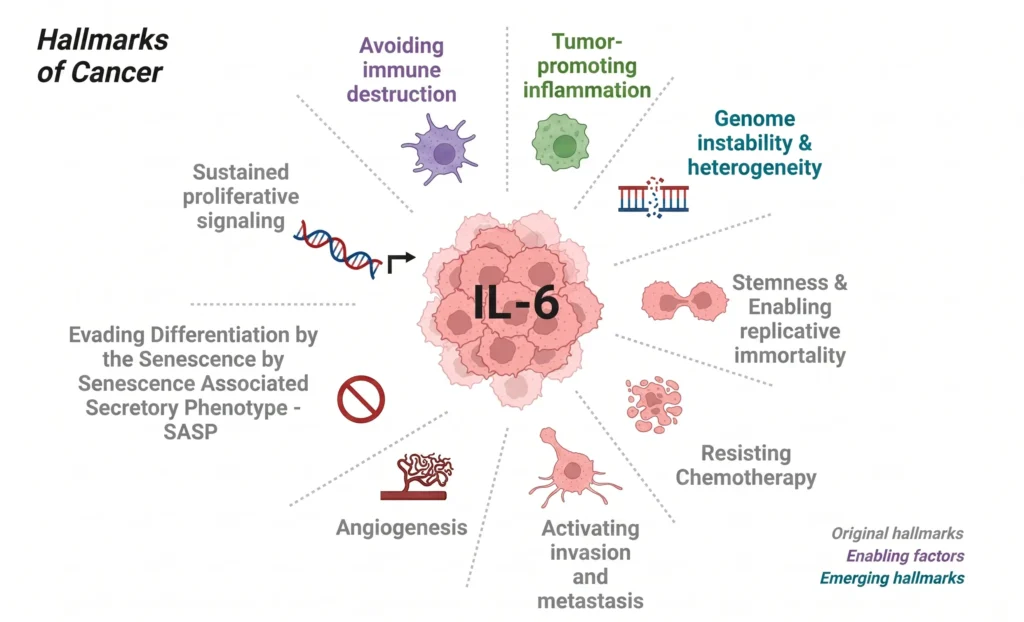
Cytokines are immune messenger molecules that act throughout the body. Interleukin-6 (IL-6) is a cytokine that plays a central role in driving many of the malignant characteristics, or “hallmarks” of cancer.14
Elevated IL-6 promotes tumor growth and survival by:
- stimulating angiogenesis (new blood vessel formation)
- enhancing chemoresistance
- increasing tumor heterogeneity (many different kinds of cancer cells)
- suppressing immune surveillance
- sustaining chronic tumor-promoting inflammation
- contributing to cancer cell invasion
- Promotes rapid proliferation
- Increases senescence-associated secretory phenotype (SASP) activity
- Maintains stem-like tumor cells that fuel recurrence.
Because of its broad influence across these pathways, IL-6 has emerged as a powerful therapeutic target.
One promising, non-pharmacologic approach for reducing IL-6 is vagal nerve stimulation (VNS). The vagus nerve activates the body’s “cholinergic anti-inflammatory pathway,” which can lower systemic IL-6 levels and, in turn, may help modulate the inflammatory microenvironment that supports cancer progression.
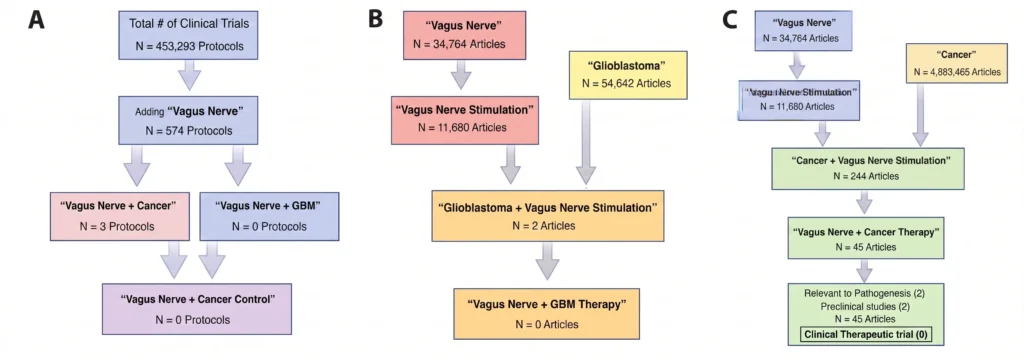
A ClinicalTrials.gov search on 6.25.2023, updated on 7.22.24 reveals no prior or current clinical trials of VNS targeting IL-6, or other cytokines, for cancer control, including glioblastoma.
Vagus nerve stimulation has been shown to slow the growth of certain cancers by enhancing the body’s immune response and regulating inflammation. This approach may improve survival outcomes in cancer patients by restoring normal metabolic functions and reducing systemic inflammation.15
Key Findings of a Systemic and Comprehensive Review:
Scientists analyzed 12 epidemiological studies looking at heart rate variability (the primary measure of vagus nerve activity) and cancer prognosis
- Higher initial vagal nerve activity correlates with better cancer outcomes and survival rates
- This relationship holds even when accounting for factors like cancer stage and treatment type
- The paper includes additional human cohort studies and animal experiments that provide stronger evidence for causation
- Vagotomy (surgical removal of the vagus nerve) accelerates tumor growth
- Vagal nerve stimulation improves cancer prognosis 16
Vagus Nerve Stimulation For Post-Surgery Fatigue In Elderly Colorectal Cancer Patients
Post-operative fatigue syndrome (POFS) causes exhaustion, sleep problems, depression, and anxiety after surgery, affecting recovery and quality of life. Research shows that surgery triggers inflammation, which contributes to these fatigue symptoms.
The vagus nerve can reduce inflammation by activating the body’s natural anti-inflammatory pathways. Both animal and human studies demonstrate that vagus nerve stimulation (VNS) effectively reduces inflammatory molecules that cause fatigue.
Given inflammation’s central role in POFS, researchers hypothesize that transcutaneous auricular vagus nerve stimulation (taVNS) could significantly reduce post-operative fatigue in elderly patients undergoing colorectal cancer surgery.17
Cancer, Anxiety, and Depression: The Vagal Connection
Cancer diagnosis and treatment can obviously cause a lot of anxiety in people. We often see people within the first month or so after their diagnosis, as they are still trying to cope with the news and figure out what their treatments are going to be and how they are going to get through treatment. After that, the most common things that we see are anxiety as well as depression.18
Low vagus nerve activity is related to a worse cancer prognosis. The vagus nerve is one of the twelve cranial nerves that extends throughout the human body (larynx, trachea, esophagus, heart, lungs, stomach and abdominal organs) and performs a variety of important functions, such as stimulating the digestive system.19 It’s also the most important nerve of the parasympathetic nervous system, which means that it helps to calm your body after a stress response by slowing down your heart rate, lowering your blood pressure, and increasing heart rate variability.20
Vagus nerve activity can be measured using the heart rate variability (HRV) that is recorded in an ECG (electrocardiogram). Various clinical studies have shown that a higher HRV is related to an improved prognosis (longer survival rates or lower tumor markers) for multiple types of cancer. 21 22 23
Clinical Studies on Vagal Activity and Cancer Prognosis
Recent studies suggest that vagal nerve activity, measured by heart rate variability (HRV), could have a prognostic role in cancer care.24 Researchers have tested the prognostic role of HRV in prostate cancer (PC) and non-small-cell lung cancer (NSCLC) patients, using a historical prospective design. HRV was derived from brief 10 sec ECGs obtained at approximately the time of diagnosis.25
In prostate cancer patients, higher HRV significantly predicted lower PSA levels at 6 and 24 months. Furthermore, this was particularly significant in metastatic PC patients, indicating moderation by stage. In NSCLC patients, HRV did not predict survival and survival times for all ages, but it did positively predict survival time in patients under the age of 65, independent of confounders.26
Vagus Nerve Activity and Cancer Staging
The parasympathetic system, and primarily the vagus nerve, inform the brain about multiple signals and bring the body back to homeostasis. Recent studies have shown that vagal nerve activity independently predicts prognosis in cancer. When vagal nerve activity is high (healthy), cancer stage no longer predicts tumor burden.27
Patients’ HRVs were derived from ECGs near diagnosis in colorectal cancer (CRC) and in prostate cancer (PC) patients. Outcomes included the tumor markers carcinoembryonic antigen (CEA) at 12 months for CRC and prostate-specific antigen (PSA) at 6 months for PC. As would be expected, initially advanced tumor stages of CRC or PC predicted higher tumor marker levels at follow-up than did early stages. However, this occurred only in patients with low, not high, vagal activity (HRV).28
Furthermore, in patients with an advanced tumor stage at diagnosis, high HRV predicted lower tumor marker levels than did low HRV, in both cancers. Estimating a cancer patient’s prognosis by determining their tumor stage also needs to consider the activity of the vagus nerve. This activity is easily measurable, and it determines in which subjects the tumor stage is prognostic. Importantly, higher vagal activity may even protect against the adverse effects of advanced cancer stage.29
Vagal Nerve Activity in Metastatic Pancreatic Cancer
A study examining the relationship between vagal nerve activity, indexed by heart rate variability (HRV), and overall survival (OS) in patients (N=272) with advanced pancreatic cancer employed a “historical prospective” design. Patients with high HRV (>20 msec) survived on average more than double the days (133.5) than those with low HRV (64.0).
Higher initial HRV was significantly correlated with lower risk of death, independent of confounders including age and cancer treatments. This relationship was statistically mediated (accounted for) by C-Reactive Protein (CRP) levels. CRP is an easily-measured blood test for inflammation. Importantly, in patients who lived up to one month from diagnosis only, HRV was unrelated to CRP, while in patients surviving longer, HRV was significantly inversely related to CRP. In other words, healthy high heart rate variability reduced inflammation in these studies.
These results are in line with possible vagal nerve protection in a fatal cancer, and the mechanism may involve neuroimmuno-modulation.30
Vagal Nerve Activity in Blood Cancers
A study examined the prognostic role of vagal nerve activity in patients with relapsed/refractory diffused large B-cell lymphoma (R/R-DLBCL) treated with chimeric antigen receptor cell therapy (CAR-T) and in patients with multiple myeloma (MM) undergoing an autologous hematopoietic cell transplantation (AutoHCT).
In DLBCL, HRV significantly predicted overall survival independently of confounders (e.g., performance status, disease status at cell therapy), hazard ratio (HR), and 95% confidence interval (HR = 0.20; 95%CI: 0.06–0.69). The prognostic role of disease severity was moderated by HRV: among severely diseased patients, 100% died with low HRV, while only 37.5% died with high HRV.
In MM, higher HRV significantly predicted progression-free survival (HR = 0.19; 95%CI: 0.04–0.90) independently of confounders. Vagal nerve activity independently predicts prognosis in patients with R/R-DLBCL and with MM undergoing cell therapy. High vagal activity overrides the prognostic role of disease severity.31
Therapeutic Potential of the Vagus Nerve in Cancer
Accumulating evidence points to a beneficial effect of vagus nerve activity in tumor development. The vagus nerve is proposed to slow tumorigenesis because of its anti-inflammatory properties mediated through ACh and the α7 nicotinic acetylcholine receptor (α7nAChR).32 Since α7nAChRs are widely expressed by many types of immune cells, researchers hypothesize that the vagus nerve affects the tumor microenvironment and anticancer immunity.33
Direct evidence in studies using animal cancer models shows that vagus nerve stimulation alters immunological responses relevant to the tumor microenvironment. Also studies in pathologies other than cancer suggest a role for the vagus nerve in altering immunological responses relevant to anticancer immunity. These results provide a rationale to expect that vagus nerve stimulation, in combination with conventional cancer treatments, may improve the prognosis of cancer patients by promoting anticancer immunity.34
Vagus Nerve Stimulation for Chemotherapy-Induced Neuropathy
Chemotherapy-induced painful peripheral neuropathy (CIPN) is a common adverse event in cancer patients, and there is still a lack of effective treatment.35 Transauricular vagal nerve stimulation (taVNS) is a minimally invasive treatment being investigated for efficacy in CIPN.
Twenty-seven patients with CIPN were randomly divided into a taVNS group (n = 14) and a sham stimulation (SS) group (n = 13). Compared with the SS group, the Numeric Rating Scale (NRS) and Athens Insomnia Scale (AIS) in the taVNS group were significantly lower. The impact lasted until day 30. TaVNS can relieve chemotherapy-induced neuropathic pain in the short term, can improve sleep status and quality of life, and is expected to become a novel clinical treatment method for Chemotherapy-induced peripheral neuropathy.36
Vagus Nerve Stimulation in Parkinson’s Disease
Recent pathophysiological theories of Parkinson’s suggest that aggregated α-synuclein forms in the gut and spreads to nuclei in the brainstem via autonomic connections.37 Noninvasive vagus nerve stimulation (nVNS) is a promising therapeutic tool to improve gait and cognitive control and ameliorate non-motor symptoms in people with Parkinson’s. 38
Evidence of nVNS as a novel therapeutic to improve gait in PD is preliminary, but early signs indicate the possibility that nVNS may be useful to target dopa-resistant gait characteristics in early PD.39 The evidence for nVNS as a therapeutic tool is, however, limited and further studies are needed in both brain health and disease.40
Vagus Nerve Stimulation Relieves Insomnia
Vagus nerve stimulation (VNS) delivered through devices or breathwork, may help people with insomnia by calming the nervous system and restoring natural sleep rhythms.
Insomnia often stems from hyperarousal, when the nervous system remains in fight-or-flight mode and can’t shift into the calm state needed for sleep. By stimulating the vagus nerve, VNS activates the parasympathetic “rest and digest” response, reducing stress and influencing brain areas that control sleep-wake cycles. It can also modulate GABA and serotonin, neurotransmitters critical for sleep regulation, and enhance deep sleep brain waves.
A meta-analysis published in May 2025 in Neuromodulation41 found that transcutaneous auricular vagus nerve stimulation (taVNS) significantly relieved insomnia across six clinical trials involving over 300 patients. TaVNS improved sleep quality, reduced time to fall asleep, and extended sleep duration.
TaVNS delivers gentle electrical pulses through the skin of the outer ear. Unlike implanted devices, which carry risks like sleep apnea and heart complications, taVNS is non-invasive, affordable, and portable.
Benefits extend beyond short-term gains. A Chinese trial in JAMA Network Open42 involving 72 participants showed that eight weeks of twice-daily taVNS improved sleep quality in chronic insomnia patients, with improvements lasting 12 weeks post-treatment. These sustained effects may result from taVNS reducing anxiety, depression, and fatigue, which are all common contributors to insomnia.
Conclusion
The vagus nerve plays a central role in connecting the brain, gut, and immune system, and its activity has important effects on health and disease. Research shows that vagal nerve activity can influence cancer growth, treatment outcomes, inflammation, fatigue, anxiety, depression, and even sleep. Higher vagus nerve activity, often measured by heart rate variability, is linked to better cancer prognosis, slower tumor growth, and improved survival across many types of cancer. Vagus nerve stimulation, whether through devices or lifestyle methods, shows promise in reducing inflammation, supporting the immune system, and improving quality of life in patients with cancer, chemotherapy side effects, Parkinson’s disease, and insomnia.
Supporting the vagus nerve is becoming an important part of Unitive medical care, helping the body regulate stress, immunity, and disease progression. By understanding and harnessing the power of this nerve, researchers, clinicians, and patients can improve long-term health outcomes in new, safe, and effective ways.
In part 3 of this series, we will dive deeper into a variety of specific methods for stimulating the vagus nerve.

- Thayer JF, Lane RD. The role of vagal function in the risk for cardiovascular disease and mortality. Biol Psychol. 2007;74(2):224-42.
- De Couck M, Maréchal R, Moorthamers S, Van Laethem JL, Gidron Y. Vagal nerve activity predicts overall survival in metastatic pancreatic cancer, mediated by inflammation. Cancer Epidemiol. 2016;40:47-51.
- Guo Y, Koshy S, Hui D, Palmer JL, Shin K, Bozkurt M, Yusuf SW. Prognostic value of heart rate variability in patients with cancer. J Clin Neurophysiol. 2015;32(6):516-20.
- Magnon C, Hall SJ, Lin J, Xue X, Gerber L, Freedland SJ, Frenette PS. Autonomic nerve development contributes to prostate cancer progression. Science. 2013;341(6142):1236361.
- Jobling P, Pundavela J, Oliveira SM, Roselli S, Walker MM, Hondermarck H. Nerve-Cancer Cell Cross-talk: A Novel Promoter of Tumor Progression. Cancer Res. 2015;75(9):1777-81.
- Zhao CM, Hayakawa Y, Kodama Y, Muthupalani S, Westphalen CB, Andersen GT, et al. Denervation suppresses gastric tumorigenesis. Sci Transl Med. 2014;6(250):250ra115.
- Renz BW, Takahashi R, Tanaka T, Macchini M, Hayakawa Y, Dantes Z, et al. β2 Adrenergic-Neurotrophin Feedforward Loop Promotes Pancreatic Cancer. Cancer Cell. 2018;33(1):75-90.e7.
- Zahalka AH, Frenette PS. Nerves in cancer. Nat Rev Cancer. 2020;20(3):143-157.
- Cole SW, Nagaraja AS, Lutgendorf SK, Green PA, Sood AK. Sympathetic nervous system regulation of the tumour microenvironment. Nat Rev Cancer. 2015;15(9):563-72.
- Kamiya A, Hayama Y, Kato S, Shimomura A, Shimomura T, Irie K, et al. Genetic manipulation of autonomic nerve fiber innervation and activity and its effect on breast cancer progression. Nat Neurosci. 2019;22(8):1289-1305.
- Kamiya, A., Hiyama, T., Fujimura, A. et al. Sympathetic and parasympathetic innervation in cancer: therapeutic implications. Clin Auton Res 31, 165–178 (2021). https://doi.org/10.1007/s10286-020-00724-y
- Mravec, B. (2024). Procedures Increasing the Activity of the Parasympathetic Nervous System. In: Neurobiology of Cancer. Springer, Cham. https://doi.org/10.1007/978-3-031-68590-3_57
- Eva Reijmen, Luca Vannucci, Marijke De Couck, Jacques De Grève, Yori Gidron,Therapeutic potential of the vagus nerve in cancer, Immunology Letters, Volume 202, 2018, Pages 38-43, ISSN 0165-2478, https://doi.org/10.1016/j.imlet.2018.07.006.
- Hunter, C.A., Jones, S.A., 2015. IL-6 as a keystone cytokine in health and disease. Nat. Immunol. 16 (5), 448–4547. https://doi.org/10.1038/ni.3153.
- Brem S. Vagus nerve stimulation: Novel concept for the treatment of glioblastoma and solid cancers by cytokine (interleukin-6) reduction, attenuating the SASP, enhancing tumor immunity. Brain Behav Immun Health. 2024 Sep 17;42:100859. doi: 10.1016/j.bbih.2024.100859. PMID: 39512605; PMCID: PMC11541944.
- e Couck M, Caers R, Spiegel D, Gidron Y. The Role of the Vagus Nerve in Cancer Prognosis: A Systematic and a Comprehensive Review. J Oncol. 2018 Jul 2;2018:1236787. doi: 10.1155/2018/1236787. PMID: 30057605; PMCID: PMC6051067
- Yin X, Qiao S, Zhang L, Li Z, Zhang Q, Shen Y, Fan K, Liu M, Wang D, Cao Y, Zhang Y, Qian L, Wu D, Wei J, Yang Y, Liu H. New intervention strategy for postoperative fatigue syndrome in elderly patients with colorectal cancer: a clinical hypothesis study based on vagus nerve stimulation. Front Med (Lausanne). 2025 Jun 2;12:1588850. doi: 10.3389/fmed.2025.1588850. PMID: 40529134; PMCID: PMC12171306.
- Pitman A, Suleman S, Hyde N, Hodgkiss A. Depression and anxiety in patients with cancer. BMJ. 2018;361:k1415
- Yuan H, Silberstein SD. Vagus nerve and vagus nerve stimulation, a comprehensive review: Part II. Headache. 2016;56(2):259-66
- Porges SW. The polyvagal theory: phylogenetic substrates of a social nervous system. Int J Psychophysiol. 2001;42(2):123-46.
- Guo Y, Koshy S, Hui D, Palmer JL, Shin K, Bozkurt M, Yusuf SW. Prognostic value of heart rate variability in patients with cancer. J Clin Neurophysiol. 2015;32(6):516-20.
- Morris R, Cunningham CJ, Manier ML, Rowland NC, Hogg E, Hicks AA, et al. Treatment of refractory epilepsy with vagus nerve stimulation and subsequent antiepileptic drug withdrawal. Seizure. 2013;22(6):456-61.
- Redgrave J, Day D, Leung H, Laud PJ, Ali A, Lindert R, et al. Safety and tolerability of Transcutaneous Vagus Nerve stimulation in humans; a systematic review. Brain Stimul. 2018;11(6):1225-1238.
- Giese-Davis J, Wilhelm FH, Tamagawa R, Palesh O, Neri E, Taylor CB, et al. Higher vagal activity as related to survival in patients with advanced breast cancer: an analysis of autonomic dysregulation. Psychosom Med. 2015;77(4):346-55.
- De Couck M, Caers R, Musch L, Fliegauf J, Giangreco A, Gidron Y. The relationship between vagus nerve activity and clinical outcomes in prostate and non-small cell lung cancer patients. Oncol Rep. 2016;35(4):2435-41.
- De Couck M, van Brummelen D, Schallier D, De Grève J, Gidron Y. The relationship between vagus nerve activity and clinical outcomes in prostate and non-small cell lung cancer patients. Oncol Rep. 2016;35(4):2435-41.
- De Couck M, Gidron Y. Norms of vagal nerve activity, indexed by Heart Rate Variability, in cancer patients. Cancer Epidemiol. 2013;37(5):737-41.
- De Couck M, Maréchal R, Moorthamers S, Van Laethem JL, Gidron Y. Vagal nerve activity predicts overall survival in metastatic pancreatic cancer, mediated by inflammation. Cancer Epidemiol. 2016;40:47-51.
- De Couck M, Maréchal R, Moorthamers S, Van Laethem JL, Gidron Y. Vagal nerve activity predicts overall survival in metastatic pancreatic cancer, mediated by inflammation. Cancer Epidemiol. 2016;40:47-51.
- De Couck M, Maréchal R, Moorthamers S, Van Laethem JL, Gidron Y. Vagal nerve activity predicts overall survival in metastatic pancreatic cancer, mediated by inflammation. Cancer Epidemiol. 2016;40:47-51.
- Gidron Y, De Couck M, De Greve J. If you have an active vagus nerve, cancer stage may not affect your survival. J Biol Regul Homeost Agents. 2014;28(2):195-201.
- Tracey KJ. The inflammatory reflex. Nature. 2002;420(6917):853-9.
- Rosas-Ballina M, Olofsson PS, Ochani M, Valdés-Ferrer SI, Levine YA, Reardon C, et al. Acetylcholine-synthesizing T cells relay neural signals in a vagus nerve circuit. Science. 2011;334(6052):98-101.
- Martelli D, McKinley MJ, Dampney RA, McAllen RM. The cholinergic anti-inflammatory pathway: a critical review. Auton Neurosci. 2014;182:65-9.
- Seretny M, Currie GL, Sena ES, Ramnarine S, Grant R, MacLeod MR, et al. Incidence, prevalence, and predictors of chemotherapy-induced peripheral neuropathy: A systematic review and meta-analysis. Pain. 2014;155(12):2461-70.
- Yu Z, Xu G, Mashanovich E, Wu S, Hao F, Xu Y. Transcutaneous auricular vagus nerve stimulation for the treatment of chemotherapy-induced peripheral neuropathy: A feasibility study. Eur J Oncol Nurs. 2019;38:50-55.
- Braak H, Rüb U, Gai WP, Del Tredici K. Idiopathic Parkinson’s disease: possible routes by which vulnerable neuronal types may be subject to neuroinvasion by an unknown pathogen. J Neural Transm (Vienna). 2003;110(5):517-36.
- Mondal B, Choudhury S, Simon B, Baker MR, Kumar H. Non-invasive vagus nerve stimulation improves gait and reduces freezing of gait in Parkinson’s disease. Mov Disord. 2019;34(12):1912-1914.
- Morris R, Cunningham CJ, Manier ML, Rowland NC, Hogg E, Hicks AA, et al. Treatment of refractory epilepsy with vagus nerve stimulation and subsequent antiepileptic drug withdrawal. Seizure. 2013;22(6):456-61.
- Redgrave J, Day D, Leung H, Laud PJ, Ali A, Lindert R, et al. Safety and tolerability of Transcutaneous Vagus Nerve stimulation in humans; a systematic review. Brain Stimul. 2018;11(6):1225-1238.
- de Oliveira HM, Gallo Ruelas M, Viana Diaz CA, Oliveira de Paula G, Fruett da Costa PR, Pilitsis JG. Transcutaneous Auricular Vagus Nerve Stimulation in Insomnia: A Systematic Review and Meta-Analysis. Neuromodulation. 2025 May 5:S1094-7159(25)00144-8. doi: 10.1016/j.neurom.2025.04.001. Epub ahead of print. PMID: 40323248.
- Zhang S, Zhao Y, Qin Z, Han Y, He J, Zhao B, Wang L, Duan Y, Huo J, Wang T, Wang Y, Rong P. Transcutaneous Auricular Vagus Nerve Stimulation for Chronic Insomnia Disorder: A Randomized Clinical Trial. JAMA Netw Open. 2024 Dec 2;7(12):e2451217. doi: 10.1001/jamanetworkopen.2024.51217. PMID: 39680406; PMCID: PMC11650411.