


By Donnie Yance
“We are living in an era of the most sophisticated technological advances, yet the treatment of cancer is paleolithic” – Azra Raza MD
If you’ve ever wondered why cancer remains so difficult to treat despite decades of research and increasingly powerful drugs, the answer lies in cancer’s remarkable ability to adapt and survive. Cancer isn’t just a collection of rogue cells—it’s a complex, intelligent system that learns, changes, and finds ways around whatever we throw at it. Understanding this adaptability is the key to developing better treatment strategies, including the integration of botanical medicine and comprehensive Mederi care approaches alongside conventional therapies.
The Challenge We Face
One of the biggest obstacles in cancer treatment today is that most advanced cancers eventually become resistant to even our most sophisticated targeted drugs.1 This isn’t a failure of medicine—it’s a reflection of cancer’s fundamental nature as an adaptive system. Cancer cells can maintain their ability to grow and spread despite significant disruptions to their internal machinery.2
Think of cancer as having multiple layers of defense, from backup systems in its molecular signaling pathways to diverse populations of cells within a single tumor, each with slightly different characteristics.3 This creates a moving target that’s incredibly difficult to hit. Recent research using systems biology—which looks at how all the parts of a biological system work together—has shown that tumors function as robust networks with built-in redundancies, feedback loops, and modular organization that help them maintain their malignant behavior.4
To truly understand and treat cancer, we need to move beyond looking at individual genes or proteins in isolation. Instead, we must consider how interconnected networks of molecules and cells work together to create the emergent properties we see in cancer.5 This is especially important because most cancers contain tremendous diversity within themselves—different cells with different characteristics—providing a reservoir of variation that allows the cancer to adapt when we attack it.6
The good news? Cancer’s robustness isn’t absolute. It’s context-dependent, which means there are vulnerabilities we can exploit.
Cancer cells possess tremendous flexibility in their form and function. This plasticity can be triggered by genetic mutations, but also by non-genetic factors like inflammatory signals from the surrounding environment, immune suppression, stem cell factors, and even the treatments we use. 7
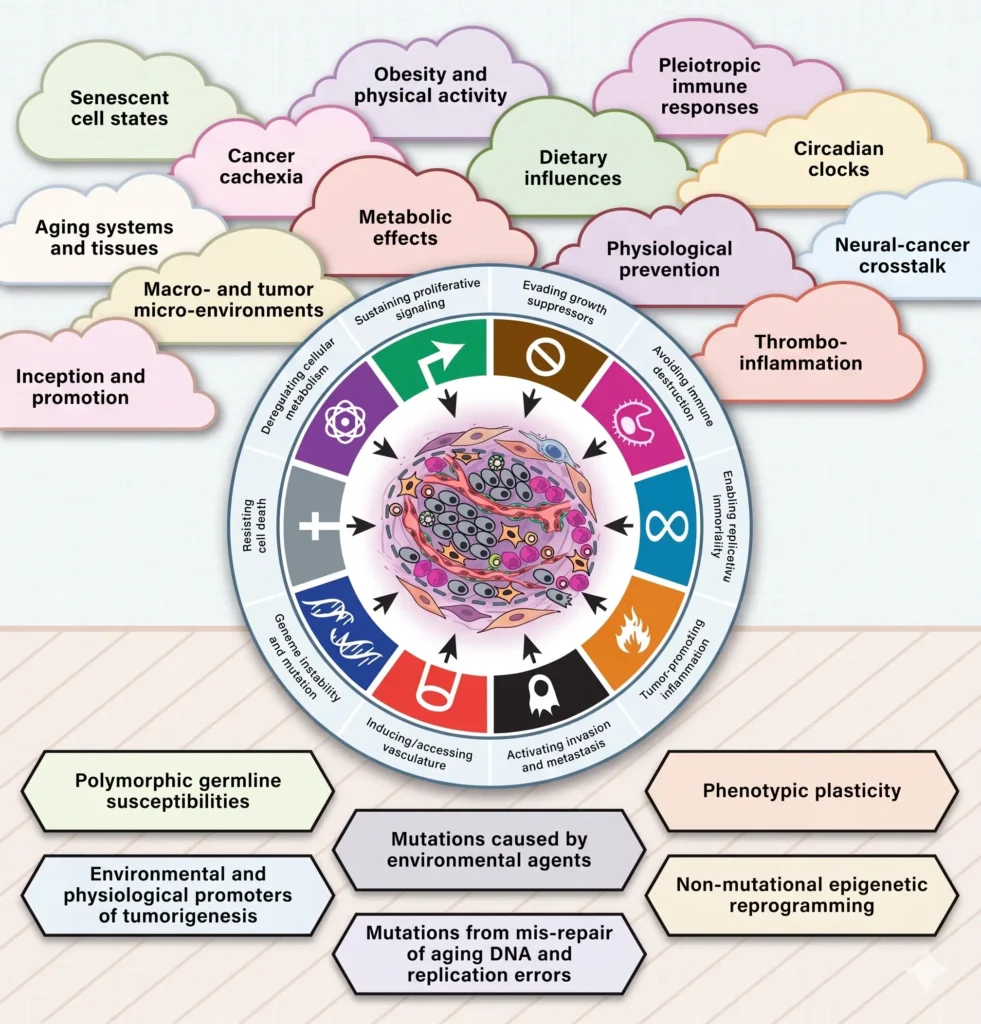
While the “hallmarks of cancer” framework has given us a useful way to think about cancer’s common features, beneath this simplicity lies dizzying complexity—both inside tumors and throughout the affected person’s body. Understanding both the complexity we can see and the underlying mechanisms we’re still discovering will be crucial for breakthrough innovations in cancer prevention and lasting treatment. 8
How Cancer Builds Its Defenses
Cancer’s robustness—its ability to maintain function despite attacks—comes from specific architectural features in its biological networks.9 Let’s break down the main defense mechanisms:
Backup Systems Everywhere
At the molecular level, cancer ensures that critical growth and survival signals can continue even when we block individual components. For example, multiple different receptor proteins on the cell surface can activate the same downstream pathway (like the PI3K/AKT pathway), so blocking one receptor often isn’t enough.10
Modular Organization
Cancer organizes its functions into semi-independent modules, like departments in a company. This compartmentalization means that even if we disrupt one module, other essential processes can continue.11
Feedback Loops
Cancer cells use both negative and positive feedback loops to maintain stability in their signaling networks. When we perturb one part of the system, these feedback mechanisms quickly compensate, restoring the signal.12
Bow-Tie Architecture
Many cancer pathways follow a “bow-tie” structure where multiple inputs funnel through a small number of core processes, which then fan out to multiple outputs. This design provides robustness while also creating potential vulnerabilities at those core bottlenecks.13
These architectural principles aren’t unique to cancer—they’re borrowed from normal cellular systems. Cancer cells essentially hijack and exaggerate the body’s own regulatory mechanisms.14 Many biological networks also follow a “scale-free” pattern, with a few highly connected hub nodes. This makes the system robust against random disruptions but vulnerable if we can target the right hubs.15
The Hidden Weakness: Robust Yet Fragile
Here’s the crucial insight from complex systems theory: when a system becomes robust against certain challenges, it necessarily becomes fragile to others.16,17 This trade-off happens because the very mechanisms that provide robustness—like feedback loops and backup pathways—require resources and create dependencies that can be exploited.
Metabolic Vulnerabilities
Cancer cells extensively rewire their metabolism to support rapid growth. While this provides robustness against nutrient limitation, it creates dependencies on specific enzymes and nutrient transporters.18 The famous “Warburg effect”—where cancer cells preferentially use a less efficient form of energy production even when oxygen is available—is a perfect example. This metabolic choice helps cancer cells in low-oxygen environments and supports their building material needs, but it makes them dependent on glucose transporters and specific enzymes.19 Though the Warburg effect helped us understand the metabolic hijacking of cancer cells and their dependency on glucose, it also caused us to oversimplify cancer and overlook the fact that cancer cells are capable of controlling virtually every metabolic pathway and nutrient source available to them.
Oncogene Addiction
Despite having multiple genetic alterations, many cancers become dependent on the continued activity of specific cancer-driving genes. This “oncogene addiction” represents a fragility that emerges when cellular networks become optimized around particular configurations.20
Synthetic Lethality
Sometimes two disruptions that are individually harmless become lethal when combined. This “synthetic lethality” exploits hidden fragilities in cancer networks.21 This doesn’t mean synthetic as in fake or artificial, it means combining two different things together. Similarly, “collateral sensitivity” occurs when resistance to one drug creates hypersensitivity to another—an adaptive response that confers robustness in one context creates vulnerability in another.22
Cancer’s Relationship with Its Environment
Cancer doesn’t exist in isolation—it’s in constant communication with its surrounding environment (the tumor microenvironment) and the host’s immune system. This relationship is critical to understanding cancer’s adaptability.
The tumor microenvironment includes blood vessels, immune cells, structural cells, signaling molecules, and the extracellular matrix. Cancer cells actively shape this environment to support their growth, creating inflammatory conditions and suppressing immune responses. In turn, the microenvironment influences cancer cell behavior, promoting stem-like properties and treatment resistance.
This dynamic, two-way relationship means that treating cancer cells alone isn’t enough—we must also address the environment that supports them and the body’s systemic response.
Why We Need Smarter, More Comprehensive Approaches
“Wisdom is a state of being. Knowledge is a function of action put into motion. Where wisdom infuses knowledge, then the heart, mind, and body become instruments of truth.” – David LaChapelle
Understanding cancer as a robust yet fragile system has profound implications for how we should treat it.23 Effective cancer treatment requires approaches that either overwhelm robustness mechanisms or exploit inherent fragilities—and ideally, both.
The Standard-of-Care Model Sets Up Strict Limitations.
Are we ready for a change?

Multi-Targeted Strategies
Rather than relying on single drugs discovered through trial-and-error, we need combination therapies designed based on network structure and dynamics.24 “Vertical inhibition” targets multiple points within a single pathway to overcome feedback-mediated resistance.25 “Horizontal combination” approaches target parallel pathways that converge on common endpoints, addressing pathway redundancy.26
Adaptive Therapy
Instead of always using maximum doses continuously, adaptive therapy modulates treatment intensity based on how the tumor responds. This approach exploits competitive interactions within the diverse tumor cell population to delay resistance evolution.27
Targeting Cancer Stem Cells
Cancer stem cells may have distinct robustness mechanisms compared to the bulk tumor population, requiring specific targeting strategies.28
Exploiting Metabolic Dependencies
Targeting metabolic vulnerabilities created by cancer’s rewiring—such as glutamine metabolism in certain cancers—exemplifies fragility-based approaches.29
Immunotherapy
Harnessing the adaptive capacity of the immune system provides a dynamic, evolving therapeutic pressure that can overcome cancer robustness.30
The Essential Role of Botanical Medicine and Mederi Care
Given cancer’s complexity, adaptability, and relationship with the whole body system, comprehensive integrative approaches like Mederi care and botanical medicine are not just complementary—they’re essential.
The Precision Paradox: Pharmaceuticals vs. Botanical Medicines
Pharmaceutical drugs typically target single molecules or pathways with high specificity—a strategy often called the “magic bullet” approach. While this precision can be remarkably powerful for initial therapeutic impact, it also creates a vulnerability: cancer’s extraordinary adaptability. When a drug blocks one specific pathway, cancer cells can often circumvent this blockade by activating backup systems, upregulating alternative pathways, or mutating the target molecule itself. This is how drug resistance emerges, sometimes within months of treatment.
Botanical medicines operate on an entirely different principle. They contain dozens or even hundreds of bioactive compounds that simultaneously influence multiple targets and pathways. Rather than overwhelming a single point, they create a distributed pressure across cancer’s metabolic network, making it far more difficult for the disease to adapt and escape.
An analogy might help clarify this distinction: Imagine pharmaceutical medicine as a bulldozer clearing a forest. It’s powerful, efficient, and follows a predetermined path with mechanical precision. But if that path is blocked—say, by a massive boulder—the bulldozer stops. It has one function, one approach, and limited adaptability.
Now imagine botanical medicine as a team of humans working together with hand tools—axes, saws, shovels, ropes, and their hands—communicating and coordinating as they move. No single tool is as powerful as the bulldozer, but the team can adapt. They understand nuance and can work around obstacles with gentleness, changing strategies mid-course and approaching problems from multiple angles simultaneously. Rather than disrupting and destroying the forest, they carefully harmonize with it, adjusting their methods based on what they encounter. When one approach fails, others continue. The work may be slower, but it’s more resilient, more flexible, and ultimately more difficult to stop.
This is the fundamental difference: precision versus adaptability, singular force versus distributed pressure, rigidity versus flexibility.
Why Botanical Medicine Matters
This multi-targeted nature of botanical medicines aligns perfectly with what we now understand about cancer network architecture. Rather than trying to find the single “magic bullet,” botanical medicines provide a constellation of effects that can:
- Modulate multiple signaling pathways simultaneously, making it harder for cancer to compensate
- Address the tumor microenvironment, reducing inflammation and immune suppression
- Support the body’s own adaptive and regulatory systems
- Influence epigenetic mechanisms that control gene expression without changing DNA
- Provide metabolic support that addresses systemic effects of cancer and treatment
Many botanical compounds have been shown to target cancer stem cells, modulate metabolic vulnerabilities, enhance immune function, and reduce the inflammatory and immune-suppressive conditions in the tumor microenvironment—addressing multiple layers of cancer’s defense systems simultaneously.
The Mederi Care Approach as Unitive Medicine
Mederi Care combines principles from both traditional and modern medical systems and employs herbal medicine as its primary treatment modality. This unique model provides a framework for developing novel therapeutic strategies while incorporating the best of holistic and conventional medicine supported by the latest scientific research at the molecular, cellular, and genomic levels.
The Mederi Care approach is not focused merely on attacking the cancer without examining the factors that allowed the cancer to arise in the first place. Practitioners develop personalized and comprehensive treatment plans based on thorough assessment and utilization of botanical, nutritional, dietary and lifestyle medicine, often with guidance regarding conventional pharmaceutical medicine.
This approach embodies Unitive Medicine—a philosophy that treats the person as an integrated whole rather than separating mind, body, and spirit. Unitive medicine is genuinely integrative when practiced at the highest level, requiring practitioners to cultivate perceptual and treatment skills that bring this unified approach to patients.
Mederi care principles represent a comprehensive, systems-based approach to cancer treatment that recognizes the patient as a whole system, not just a tumor to be eliminated. This approach:
- Addresses the Terrain: Rather than focusing solely on killing cancer cells, Mederi care works to modify the internal environment that allows cancer to thrive, including metabolic, inflammatory, and immune factors
- Supports Resilience: By strengthening the body’s own regulatory and adaptive systems, this approach helps patients better tolerate conventional treatments and resist cancer progression
- Personalizes Treatment: Recognizing that each patient’s cancer exists within a unique biological context, Mederi care tailors interventions to individual needs
- Integrates Multiple Modalities: Combining botanical medicine, nutrition, lifestyle modifications, and mind-body approaches with conventional treatments creates a multi-layered strategy that matches cancer’s multi-layered defenses
- Focuses on Long-term Outcomes: Rather than just short-term tumor response, this approach aims for durable remissions and improved quality of life
Complementing, Not Replacing, Conventional Treatment
It’s crucial to understand that botanical medicine and Mederi care are not alternatives to conventional cancer treatment—they’re essential complements. As targeted drugs and immunotherapies become more sophisticated, they become more powerful at disrupting specific cancer mechanisms. However, cancer’s adaptive capacity means that these powerful interventions often trigger compensatory responses.
This is where integrative approaches become invaluable. By simultaneously:
- Supporting the body’s resilience and regulatory capacity
- Modulating the tumor microenvironment
- Addressing multiple pathways with botanical medicines
- Reducing treatment side effects that might otherwise limit therapy
- Targeting cancer stem cells and metabolic vulnerabilities
…we can create a comprehensive strategy that’s greater than the sum of its parts.
Computational modeling combined with experimental validation is now enabling us to predict optimal combinations of drugs and treatment schedules that account for network dynamics and evolutionary constraints.31 The future of cancer treatment lies in integrating these sophisticated conventional approaches with equally sophisticated botanical and integrative strategies.
Hope Through Integration
The complexity of cancer—its adaptability, its relationship with the microenvironment, its robust yet fragile nature—might seem overwhelming. But understanding this complexity actually gives us hope and direction.
We now know that cancer’s robustness has limits and creates vulnerabilities. We understand that cancer exists as part of a larger system—the patient’s body—and that addressing the whole system is essential. We recognize that multi-targeted, adaptive, comprehensive approaches are more likely to succeed than single-agent therapies.
The integration of conventional medicine’s increasingly powerful targeted therapies with botanical medicine’s multi-targeted effects and Mederi care’s systems-based approach represents our best strategy for meeting cancer’s complexity with equal sophistication.
Cancer may be adaptable, but so are we. By combining the precision of modern pharmacology with the wisdom of botanical medicine and the comprehensive perspective of integrative care, we’re developing smarter, more effective approaches that address cancer as the complex adaptive system it truly is.
The Mederi Care approach recognizes that cancer doesn’t develop in a vacuum. It emerges from an imbalanced terrain—a body system that’s been compromised by some combination of chronic inflammation, trauma, toxin exposure, poor nutrition, stress, and immune dysfunction.
Rather than just attacking cancer cells, we focus on restoring balance to the whole system. This multi-targeted approach naturally exploits cancer’s vulnerabilities while strengthening the body’s inherent healing capacity.

- Khan SU, Fatima K, Aisha S, Malik F. Unveiling the mechanisms and challenges of cancer drug resistance. Cell Commun Signal. 2024 Feb 12;22(1):109. doi: 10.1186/s12964-023-01302-1. PMID: 38347575; PMCID: PMC10860306.
- Swanton C, Bernard E, Abbosh C, André F, Auwerx J, Balmain A, Bar-Sagi D, Bernards R, Bullman S, DeGregori J, Elliott C, Erez A, Evan G, Febbraio MA, Hidalgo A, Jamal-Hanjani M, Joyce JA, Kaiser M, Lamia K, Locasale JW, Loi S, Malanchi I, Merad M, Musgrave K, Patel KJ, Quezada S, Wargo JA, Weeraratna A, White E, Winkler F, Wood JN, Vousden KH, Hanahan D. Embracing cancer complexity: Hallmarks of systemic disease. Cell. 2024 Mar 28;187(7):1589-1616. doi: 10.1016/j.cell.2024.02.009. PMID: 38552609; PMCID: PMC12077170.
- Tang DG, Kondo T. Cancer cell heterogeneity and plasticity: From molecular understanding to therapeutic targeting. Semin Cancer Biol. 2022 Jul;82:1-2. doi: 10.1016/j.semcancer.2021.10.001. Epub 2021 Oct 6. PMID: 34626799; PMCID: PMC9361306.
- Du, W., Elemento, O. Cancer systems biology: embracing complexity to develop better anticancer therapeutic strategies. Oncogene34, 3215–3225 (2015). https://doi.org/10.1038/onc.2014.291
- Barabási, A. L., Gulbahce, N., & Loscalzo, J. (2011). Network medicine: a network-based approach to human disease. Nature Reviews Genetics, 12(1), 56-68.
- Marusyk, A., Almendro, V., & Polyak, K. (2012). Intra-tumour heterogeneity: a looking glass for cancer? Nature Reviews Cancer, 12(5), 323-334.
- Swanton C, Bernard E, Abbosh C, André F, Auwerx J, Balmain A, Bar-Sagi D, Bernards R, Bullman S, DeGregori J, Elliott C, Erez A, Evan G, Febbraio MA, Hidalgo A, Jamal-Hanjani M, Joyce JA, Kaiser M, Lamia K, Locasale JW, Loi S, Malanchi I, Merad M, Musgrave K, Patel KJ, Quezada S, Wargo JA, Weeraratna A, White E, Winkler F, Wood JN, Vousden KH, Hanahan D. Embracing cancer complexity: Hallmarks of systemic disease. Cell. 2024 Mar 28;187(7):1589-1616. doi: 10.1016/j.cell.2024.02.009. PMID: 38552609; PMCID: PMC12077170.
- Swanton C, Bernard E, Abbosh C, André F, Auwerx J, Balmain A, Bar-Sagi D, Bernards R, Bullman S, DeGregori J, Elliott C, Erez A, Evan G, Febbraio MA, Hidalgo A, Jamal-Hanjani M, Joyce JA, Kaiser M, Lamia K, Locasale JW, Loi S, Malanchi I, Merad M, Musgrave K, Patel KJ, Quezada S, Wargo JA, Weeraratna A, White E, Winkler F, Wood JN, Vousden KH, Hanahan D. Embracing cancer complexity: Hallmarks of systemic disease. Cell. 2024 Mar 28;187(7):1589-1616. doi: 10.1016/j.cell.2024.02.009. PMID: 38552609; PMCID: PMC12077170.
- Stelling, J., Sauer, U., Szallasi, Z., Doyle III, F. J., & Doyle, J. (2004). Robustness of cellular functions. Cell, 118(6), 675-685.
- Engelman, J. A., Luo, J., & Cantley, L. C. (2006). The evolution of phosphatidylinositol 3-kinases as regulators of growth and metabolism. Nature Reviews Genetics, 7(8), 606-619.
- Hartwell, L. H., Hopfield, J. J., Leibler, S., & Murray, A. W. (1999). From molecular to modular cell biology. Nature, 402(6761), C47-C52.
- Brandman, O., & Meyer, T. (2008). Feedback loops shape cellular signals in space and time. Science, 322(5900), 390-395.
- Csete, M., & Doyle, J. (2004). Bow ties, metabolism and disease. Trends in Biotechnology, 22(9), 446-450.
- Hanahan, D., & Weinberg, R. A. (2011). Hallmarks of cancer: the next generation. Cell, 144(5), 646-674.
- Barabási, A. L., & Oltvai, Z. N. (2004). Network biology: understanding the cell’s functional organization. Nature Reviews Genetics, 5(2), 101-113.
- Cairns, R. A., Harris, I. S., & Mak, T. W. (2011). Regulation of cancer cell metabolism. Nature Reviews Cancer, 11(2), 85-95.
- Kitano, H. (2004). Cancer as a robust system: implications for anticancer therapy. Nature Reviews Cancer, 4(3), 227-235.
- Vander Heiden, M. G., Cantley, L. C., & Thompson, C. B. (2009). Understanding the Warburg effect: the metabolic requirements of cell proliferation. Science, 324(5930), 1029-1033.
- Cairns, R. A., Harris, I. S., & Mak, T. W. (2011). Regulation of cancer cell metabolism. Nature Reviews Cancer, 11(2), 85-95.
- Weinstein, I. B., & Joe, A. (2008). Oncogene addiction. Cancer Research, 68(9), 3077-3080.
- Kaelin Jr, W. G. (2005). The concept of synthetic lethality in the context of anticancer therapy. Nature Reviews Cancer, 5(9), 689-698.
- Pluchino, K. M., Hall, M. D., Goldsborough, A. S., Callaghan, R., & Gottesman, M. M. (2012). Collateral sensitivity as a strategy against cancer multidrug resistance. Drug Resistance Updates, 15(1-2), 98-105.
- Kitano, H. (2007). A robustness-based approach to systems-oriented drug design. Nature Reviews Drug Discovery, 6(3), 202-210.
- Fitzgerald, J. B., Schoeberl, B., Nielsen, U. B., & Sorger, P. K. (2006). Systems biology and combination therapy in the quest for clinical efficacy. Nature Chemical Biology, 2(9), 458-466.
- Carracedo, A., Ma, L., Teruya-Feldstein, J., Rojo, F., Salmena, L., Alimonti, A., … & Pandolfi, P. P. (2008). Inhibition of mTORC1 leads to MAPK pathway activation through a PI3K-dependent feedback loop in human cancer. Journal of Clinical Investigation, 118(9), 3065-3074.
- Stommel, J. M., Kimmelman, A. C., Ying, H., Nabioullin, R., Ponugoti, A. H., Wiedemeyer, R., … & DePinho, R. A. (2007). Coactivation of receptor tyrosine kinases affects the response of tumor cells to targeted therapies. Science, 318(5848), 287-290.
- Gatenby, R. A., Silva, A. S., Gillies, R. J., & Frieden, B. R. (2009). Adaptive therapy. Cancer Research, 69(11), 4894-4903.
- Reya, T., Morrison, S. J., Clarke, M. F., & Weissman, I. L. (2001). Stem cells, cancer, and cancer stem cells. Nature, 414(6859), 105-111.
- Wise, D. R., DeBerardinis, R. J., Mancuso, A., Sayed, N., Zhang, X. Y., Pfeiffer, H. K., … & Thompson, C. B. (2008). Myc regulates a transcriptional program that stimulates mitochondrial glutaminolysis and leads to glutamine addiction. Proceedings of the National Academy of Sciences, 105(48), 18782-18787.
- Mellman, I., Coukos, G., & Dario, G. (2011). Cancer immunotherapy comes of age. Nature, 480(7378), 480-489.
- Zhao, B., Pritchard, J. R., Lauffenburger, D. A., & Hemann, M. T. (2014). Addressing genetic tumor heterogeneity through computationally predictive combination therapy. Cancer Discovery, 4(2), 166-174.







2 Responses
Another great piece, Donnie . . . thanks for all your work discovering these things, and for sharing this information with the world!
I was referred to your work by my friend Tracy Dwyer.
She gifted me your book Herbal Medicine, Healing and cancer and Adaptogens in medical Herbalism. I I very much resonate with your work.
Best,
Joan Schnitzer