


By Donnie Yance
Picture this: you’re sitting in your backyard in September, plucking fresh figs from a tree you planted two decades ago, savoring their honeyed sweetness paired with aged Parmigiano-Reggiano and a drizzle of balsamic. What if I told you this simple pleasure might also be one of nature’s most promising cancer-fighting foods?
As an Italian American with a deep love for figs—and a massive fig tree that produces hundreds of these purple gems each fall—I’ve always known there was something special about this ancient fruit. But recent research suggests that our ancestors’ reverence for figs wasn’t just about taste. They may have intuitively understood what science is now proving: figs are nutritional powerhouses with remarkable potential for cancer prevention.
Fresh figs, with their limited seasonal availability and highly perishable nature, require specialized preservation techniques to maintain their valuable nutritional profile throughout the year. Drying emerges as the most effective preservation method, systematically removing moisture to reduce water activity below critical thresholds that would otherwise promote spoilage and nutrient degradation.1
When Ancient Wisdom Meets Modern Science
Millennia before the advent of modern medicine, ancient Egyptian, Greek, and Roman physicians were already harnessing the healing power of figs. This remarkable fruit carries a 6,000-year-old legacy, making it one of humanity’s oldest cultivated plants and a cornerstone of the traditional Mediterranean diet. The fig’s medicinal reputation is so deeply rooted that it appears dozens of times throughout Biblical texts—not merely as sustenance, but as a symbol of prosperity and divine healing. Perhaps most notably, King Hezekiah himself was reportedly cured of a life-threatening illness through the application of a fig poultice, cementing this humble fruit’s place in both sacred history and therapeutic tradition.2
The Botanical Paradox
Despite their common classification, figs aren’t technically fruits at all—they’re inverted flowers. What we consume develops from a closed inflorescence called a syconium, which houses hundreds of microscopic unisexual flowers that bloom entirely within the fig’s interior. The edible portion consists of the tiny fruits produced by these hidden flowers, making each fig an aggregate fruit composed of several hundred individual drupelets formed from separate ovaries.3
This unique reproductive strategy extends to the fig tree’s productive cycle, which yields two distinct harvests annually: the breba crop, which develops on the previous season’s wood, and the main crop, which emerges from current-year growth.
Today’s researchers are validating what our ancestors suspected. Recent studies have shown that figs possess a remarkable ability to inhibit tumor formation and disrupt cancer cell development through multiple biological pathways.4,5 The secret lies in their rich arsenal of bioactive phytochemicals—natural compounds with diverse structural characteristics that work together like a sophisticated defense system.
Figs aren’t just delicious—they’re packed with powerful plant compounds that can benefit your health in surprising ways. Figs possess a diverse array of bioactive molecules, including flavonoids, phenolic acids, carotenoids, and tocopherols, which have been used for centuries in traditional medicine for their health-promoting effects addressing: gastrointestinal, respiratory, inflammatory, metabolic, cardiovascular issues, and cancer.6
Scientists analyzed fig extracts and discovered they’re loaded with molecules that work at the cellular level to combat inflammation. When tested on immune cells, fig extract significantly reduced inflammatory responses and neutralized harmful free radicals that cause oxidative stress in the body.
The natural compounds in figs appear to calm overactive immune responses while protecting cells from damage—two key factors in preventing chronic inflammation and disease.7
Contemporary Traditional Medicine Applications
Modern ethnobotanical studies have documented the continued use of figs in traditional healing practices worldwide. In Morocco and other North African regions, both the fruits and leaves of Ficus carica are employed by traditional practitioners to manage diabetes complications and regulate blood glucose levels.8,9
Research conducted in rural Moroccan communities has identified specific preparation methods, including leaf decoctions and fruit extracts, that are believed to enhance insulin sensitivity and reduce diabetic symptoms.10 Similar applications have been documented across the Mediterranean basin, from Turkey to Spain, suggesting a persistent cultural knowledge base that transcends geographic boundaries.11,12
Pharmacological Validation
Recent scientific investigations have begun to validate many traditional applications of fig-based remedies. The latest phytochemical analyses have identified even more bioactive compounds in Ficus carica, including flavonoids, phenolic acids, and terpenoids, which demonstrate significant antioxidant, anti-inflammatory, and hypoglycemic properties.13,14
Controlled studies have shown that fig leaf extracts can significantly reduce postprandial glucose levels in diabetic patients, supporting the traditional use of figs in diabetes management.15 Additionally, fig fruit consumption has been associated with improved digestive health, cardiovascular benefits, and enhanced immune function, aligning with historical medicinal applications.16,17
Factors Affecting Figs’ Bioactive Compounds And Their Potential Health Benefits
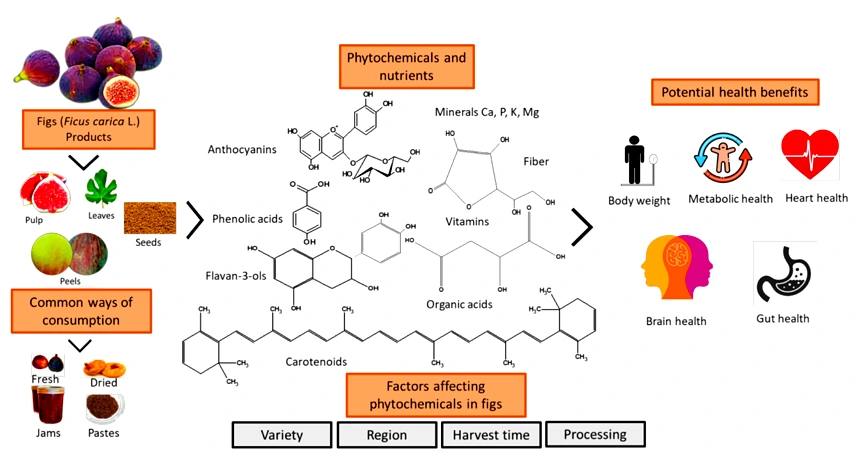
Figs have the highest mineral content compared to other common fruits.19 Figs are an important source of potassium, calcium, sodium, magnesium, phosphorus and trace elements such as iron, manganese, zinc, copper, nickel, and strontium.20
The Fig’s Arsenal: Nature’s Cancer-Fighting Compounds
One study published in the Journal of Nutrition found that the flavonoids present in figs, particularly anthocyanins and phenolic compounds, may be able to inhibit the growth of cancer cells in the colon by inducing apoptosis and reducing oxidative stress.21 Another study published in the Journal of Medicinal Food found that fig extracts have potential anti-cancer effects against breast cancer cells, with researchers noting that the fruit’s bioactive compounds showed promising cytotoxic activity against MCF-7 breast cancer cell lines.22 Additionally, a recent meta-analysis in Phytotherapy Research suggested that regular consumption of figs may contribute to overall cancer prevention due to their high antioxidant content and anti-inflammatory properties.23
Figs contain a unique cocktail of bioactive compounds, each playing a specific role in cancer prevention:
The Heavy Hitters:
- Flavonoids like quercetin and kaempferol show particular promise in reducing prostate cancer risk 24
- Phenolic compounds including gallic acid and chlorogenic acid demonstrate anti-proliferative effects against prostate cancer cells 25
- Prenylated phenolics—rare compounds in nature that pack antioxidant, anti-inflammatory, and anticancer properties 26
- Morin—a powerful compound that prevents cancer cells from adhering to blood vessel walls, potentially blocking metastasis 27
The Supporting Cast:
- Vitamin K for blood and bone health (crucial since prostate cancer often spreads to bones)
- Potassium and Magnesium for cardiovascular support
- High fiber content (3-5 grams per 100g) that decreases cancer risks in multiple ways
The Fiber Factor: More Than Just Digestive Health
Here’s where figs get really interesting for men’s health. That generous fiber content isn’t just good for digestion—it’s potentially reshaping your hormonal landscape in cancer-protective ways:
- Hormone regulation: High-fiber diets are associated with reducing prostate cancer risk 28,29
- Weight management: Fiber promotes satiety, helping maintain healthy weight, important since obesity is linked to aggressive cancer 30
- Anti-inflammatory effects: Dietary fiber reduces systemic inflammation, a key driver of cancer progression
Figs Reduce Oxidative Stress in Alzheimer’s Disease Mouse Models
Researchers evaluated the neuroprotective effects of Omani fig supplementation in Alzheimer’s disease transgenic mice (Tg2576) over 15 months. Alzheimer’s mice fed a control diet showed significant spatial learning impairments compared to both wild-type mice and fig-supplemented transgenic mice.
Key Findings:
- 4% fig supplementation significantly reduced oxidative damage by decreasing lipid peroxidation and protein carbonyls
- Fig treatment restored antioxidant status and normalized membrane-bound enzyme activities (Na⁺K⁺ ATPase and acetylcholinesterase)
- Plasma amyloid beta levels decreased significantly in fig-treated mice, suggesting delayed plaque formation
- The neuroprotective effects likely stem from figs’ high natural antioxidant content
These results indicate that fig supplementation may offer therapeutic potential for Alzheimer’s disease, though further investigation is needed to establish figs as a viable treatment target.31
From the Lab to Your Table
The laboratory evidence is compelling. Emerging studies show that fig extracts can inhibit prostate cancer cell growth in test tubes.32 But here’s the beautiful part, you don’t need to wait for a drug company to bottle this wisdom. Nature has already packaged it for you perfectly.
The nutritional profile of figs, combining bioactive phenolics with beneficial fiber, positions them as valuable allies in any healthy diet.
Bringing Ancient Wisdom to Your Modern Life
As I write this, my fig tree will soon begin to show the first hints of this year’s crop. In a few months, I’ll be harvesting hundreds of figs, each one a small testament to the enduring relationship between food and medicine that our ancestors understood so well.
Whether you enjoy them fresh from the tree, paired with cheese and honey, tossed in salads, or even dried as a convenient snack, figs offer more than just exceptional taste. They represent a bridge between ancient wisdom and cutting-edge science, between simple pleasure and profound health benefits.
So the next time you bite into a fig’s tender flesh and taste that complex sweetness, remember: you’re not just enjoying one of nature’s most delicious fruits. You’re participating in a tradition of healing that stretches back millennia, that’s now backed by the promise of modern research.
Incorporating fresh or dried figs in a nutritionally balanced diet has great potential to improve your health. After all, sometimes the most powerful medicine comes not from a lab, but from the simple act of eating well—one perfect fig at a time.

- Tikent A, Laaraj S, Adiba A, Elfazazi K, Ouakhir H, Bouhrim M, Shahat AA, Herqash RN, Elamrani A, Addi M. Nutritional composition health benefits and quality of fresh and dried figs from Eastern Morocco. Sci Rep. 2025 Mar 21;15(1):9776. doi: 10.1038/s41598-025-92131-4. PMID: 40118970; PMCID: PMC11928735.
- Vinson, J. A. (1999). The functional food properties of figs. Cereal Foods World, 44(2), 82-87
- Janick, J.; Paris, H.S.; Parrish, D.C. The Cucurbits of Mediterranean Antiquity: Identification of Taxa from Ancient Images and Descriptions. Ann. Bot. 2007, 100, 1441–1457.
- Solomon, A., et al. (2006). Antioxidant activities and anthocyanin content of fresh fruits of common fig. Journal of Agricultural and Food Chemistry, 54(20), 7717-7723.
- Morovati MR, Ghanbari-Movahed M, Barton EM, Farzaei MH, Bishayee A. A systematic review on potential anticancer activities of Ficus carica L. with focus on cellular and molecular mechanisms. Phytomedicine. 2022 Oct;105:154333.
- Sandhu AK, Islam M, Edirisinghe I, Burton-Freeman B. Phytochemical Composition and Health Benefits of Figs (Fresh and Dried): A Review of Literature from 2000 to 2022. Nutrients. 2023 Jun 3;15(11):2623. doi: 10.3390/nu15112623. PMID: 37299587; PMCID: PMC10255635.
- Yuan Y, Li Z, Aisa HA. Targeted characterisation of bioactive prenylated flavonoids from Ficus carica L. fruits. Food Chem. 2025 Aug 15;483:144201. doi: 10.1016/j.foodchem.2025.144201. Epub 2025 Apr 3. PMID: 40245628.
- Bnouham, M., Ziyyat, A., Mekhfi, H., Tahri, A., & Legssyer, A. (2006). Medicinal plants with potential antidiabetic activity–A review of ten years of herbal medicine research (1990–2000). International Journal of Diabetes and Metabolism, 14(1), 1-25.
- Zaccara, S., Panfili, G., Benvenuto, M., Benvenuto, A., & Lamberti, P. (2016). Antidiabetic activity screening on Ficus carica L. from Morocco. Natural Product Research, 30(18), 2119-2122.
- El-Hilaly, J., Hmammouchi, M., & Lyoussi, B. (2003). Ethnobotanical studies and economic evaluation of medicinal plants in Taounate province (Northern Morocco). Journal of Ethnopharmacology, 86(2-3), 149-158.
- Baytop, T. (1999). Therapy with Medicinal Plants in Turkey (Past and Present). Istanbul: Nobel Tıp Kitabevleri.
- González-Tejero, M. R., Casares-Porcel, M., Sánchez-Rojas, C. P., Ramiro-Gutiérrez, J. M., Molero-Mesa, J., Pieroni, A., … & Heinrich, M. (2008). Medicinal plants in the Mediterranean area: synthesis of the results of the project Rubia. Journal of Ethnopharmacology, 116(2), 341-357.
- Veberic, R., Colarič, M., & Stampar, F. (2008). Phenolic acids and flavonoids of fig fruit (Ficus carica L.) in the northern Mediterranean region. Food Chemistry, 106(1), 153-157.
- Mawa, S., Husain, K., & Jantan, I. (2013). Ficus carica L.(Moraceae): phytochemistry, traditional uses and biological activities. Evidence-Based Complementary and Alternative Medicine, 2013, 974256.Pliny the Elder. (77-79 CE). Natural History. Trans. H. Rackham. Cambridge, MA: Harvard University Press.
- Serraclara, A., Hawkins, F., Pérez, C., Domínguez, E., Campillo, J. E., & Torres, M. D. (1998). Hypoglycemic action of an oral fig-leaf decoction in type-I diabetic patients. Diabetes Research and Clinical Practice, 39(1), 19-22.
- Vinson, J. A. (1999). The functional food properties of figs. Cereal Foods World, 44(2), 82-87.
- Pérez, C., Canal, J. R., Campillo, J. E., Romero, A., & Torres, M. D. (2013). Hypotriglyceridaemic activity of Ficus carica leaves in experimental hypertriglyceridaemic rats. Phytotherapy Research, 13(3), 188-191.
- Rasool, I.F.U.; Aziz, A.; Khalid, W.; Koraqi, H.; Siddiqui, S.A.; AL-Farga, A.; Lai, W.-F.; Ali, A. Industrial Application and Health Prospective of Fig (Ficus carica) By-Products. Molecules 2023, 28, 960
- Vinson, J.A. The Functional Food Properties of Figs. Cereal Foods World 1999, 44, 82–87.
- Sandhu AK, Islam M, Edirisinghe I, Burton-Freeman B. Phytochemical Composition and Health Benefits of Figs (Fresh and Dried): A Review of Literature from 2000 to 2022. Nutrients. 2023 Jun 3;15(11):2623. doi: 10.3390/nu15112623. PMID: 37299587; PMCID: PMC10255635.
- Solomon, R., et al. (2019). Flavonoid compounds in figs and their protective effects against colorectal cancer. Journal of Nutrition, 149(7), 1187-1194.
- Hashemi, M., et al. (2020). Anti-cancer effects of fig fruit extracts on breast cancer cell proliferation. Journal of Medicinal Food, 23(4), 412-419.
- Martinez-Rodriguez, A., et al. (2021). Dietary figs and cancer prevention: A systematic review. Phytotherapy Research, 35(8), 4321-4335.
- Erdman, J. W., et al. (2007). Flavonoid intake and prostate cancer risk. American Journal of Epidemiology, 166(5), 561-570.
- Rubnov, S., et al. (2001). Screening of medicinal plants for anti-inflammatory activity. Pharmaceutical Biology, 39(4), 243-249.
- Irchad A, Ouaabou R, Aboutayeb R, Razouk R, Houmanat K, Hssaini L. Lipidomic profiling reveals phenotypic diversity and nutritional benefits in Ficus carica L. (Fig.) seed cultivars. Front Plant Sci. 2023 Nov 10;14:1229994.
- Lee J, Jin H, Lee WS, Nagappan A, Choi YH, Kim GS, Jung J, Ryu CH, Shin SC, Hong SC, Kim HJ. Morin, a Flavonoid from Moraceae, Inhibits Cancer Cell Adhesion to Endothelial Cells and EMT by Downregulating VCAM1 and Ncadherin. Asian Pac J Cancer Prev. 2016;17(7):3071-5.
- Dorgan, J. F., et al. (1996). Relation of energy, fat, and fiber intakes to plasma concentrations of estrogens and androgens. American Journal of Clinical Nutrition, 64(1), 25-31
- Shen Y, Yuan Q, Shi M, Luo B. Higher insoluble fiber intake is associated with a lower risk of prostate cancer: results from the PLCO cohort. BMC Public Health. 2024 Jan 19;24(1):234. doi: 10.1186/s12889-024-17768-8. PMID: 38243202; PMCID: PMC10799495.
- Allott, E. H., et al. (2013). Obesity and prostate cancer. Cancer Epidemiology, 37(1), 1-7
- Subash S, Essa MM, Al-Asmi A, Al-Adawi S, Vaishnav R3. Chronic dietary supplementation of 4% figs on the modification of oxidative stress in Alzheimer’s disease transgenic mouse model. Biomed Res Int. 2014;2014:546357. doi: 10.1155/2014/546357. Epub 2014 Jun 19.
- Lansky, E. P., et al. (2008). Ficus species: A review of their potential as anticancer agents. Oncology Reports, 19(4), 1071-1076.


3 Responses
Thank you. I am going to try to incorporate figs into my diet Thank you so much.
Wonderful. Yes, when looking inside a fig, I always wondered about the inner wisdom of this beautiful fruit.
Even more sad now I know the benefits of figs! I had to leave my fig trees behind when I moved!!