
By Donnie Yance
As we stand at the threshold of Easter, Passover, and Spring—this season of renewal when the earth itself demonstrates resurrection—we are invited into one of life’s most profound mysteries: that creation cannot occur without prior destruction, that new life emerges only when space has been cleared, that transformation requires us to release what we have been in order to become what we are meant to be.
Look around you. The earth is waking from its winter sleep, and everywhere we turn, we witness the miracle of resurrection. Crocuses push through the last patches of snow, their purple and gold heads defiant against the cold. Trees that stood bare and seemingly lifeless for months now swell with buds, their branches heavy with the promise of leaves and blossoms. The forsythia explodes in yellow fire. Cherry trees dress themselves in clouds of pink and white. Daffodils trumpet their golden announcement: death has not won; life returns; the cycle continues.
But notice what had to happen first. The seed had to fall into the ground and die, breaking open in the darkness of soil, surrendering its hard shell so that the tender shoot could emerge. The bulb had to endure the freezing earth, seemingly buried and forgotten, before it could send up its green spear toward the light. The tree had to let go of every leaf, standing naked and vulnerable through the harsh months, trusting that spring would come again. The forest fire had to clear the undergrowth before new saplings could find sun. The star had to collapse before fresh stars could be born.
This is nature’s ancient wisdom, written into every living being and season: transformation requires surrender. New life demands that we release our grip on the old. The earth teaches us that resurrection is not merely survival—it is radical rebirth, the emergence of something entirely new from what appeared to be dead and gone. And so we, too, are invited into this sacred pattern. As the flowers break through winter’s hard ground, we are called to break through our own hardened places. As the trees bud with new growth, we are invited to allow new life to emerge within us. As the whole earth demonstrates that death is not the end but the doorway to resurrection, we are offered the opportunity to enter our own transformation—to dismantle our assumptions, our certainties, our very sense of self, so that something more beautiful, more true, and more alive can take root and flourish within us.
The Choice Before Us
The answer to this question determines everything. It shapes not only how we live but who we become. For when we resist the Spirit’s movement, we calcify. We become rigid, defensive, and closed. But when we surrender to that movement—when we allow the Spirit to transform us—we discover our capacity to become the best that we can be through love.
Love is the force that challenges us to move, and move we must. There is no place for stagnation, for it is the root of disease – stagnant blood, stagnant lymph, stagnant oxygen, and stagnant emotions contribute to chronic disease. As Winston Churchill is thought to have said, “If you’re going through hell, keep going” Grief cannot sit still. It will eat you alive if you let it stagnate within you. However, if we let Spirit guide us, we can move forward to a new place filled with love. Agape love. Love with pain, yes, but also love with joy. Love that has been deepened and purified by loss. Love that has learned to hold both sorrow and gratitude in the same breath.
This is the love that Pope Francis spoke of when he said, “Before there was God, there was Love.” This is the love that Richard Rohr describes as “the greatest mystery of all.” Not love as a warm and fuzzy feeling, but love as the animating force that holds us together. If we can believe that we are loved just as we are and that everything else is equally loved, we unveil a cosmic reality that is life-giving and a God-like reality that affirms the goodness of all creation.
The Call to Be Salt
In Matthew’s Gospel, Jesus tells us to be salt of the earth—not the meat, the potatoes, or even the vegetables—just the invisible but very effective salt. Salt is what gives zing and taste to food, and Jesus is calling us to be people who give purpose, meaning, and desire to life.
Think about this calling. We are not asked to be the main course, the centerpiece, the thing everyone notices first. We are asked to be the subtle presence that makes everything else come alive. The quiet influence that brings out the best in others. The humble element that, though often unnoticed, makes all the difference.
This is the essence of humility—and humility, as we discover in this season of renewal, is the guardian and ornament of all virtues.
Humility: Holding Others High
To be “humble” does not mean being diffident, timid, bashful, or lacking in self-confidence. It means honoring others and regarding them as important, no less important than you are. It does not mean holding yourself low; it means holding other people high. True humility comes from a place of strength.
David, the giant-slayer who became king, understood this. While pondering God’s creation, he mused: “When I consider Your heavens, the work of Your fingers, the moon and the stars, which You have ordained, what is man that You are mindful of him, and the son of man that You visit him?” (Psalm 8:3-4)
And Jesus himself embodied this paradox of strength and humility. He didn’t adopt humility merely to accomplish his task on earth. “Take my yoke upon you and learn from me,” he said, “for I am gentle and humble in heart, and you will find rest for your souls” (Matthew 11:29). Humility is part of God’s eternal nature.
When Pope Francis first addressed the world as pope, he demonstrated this same strength and humility. “Before the bishop blesses the people,” he said, referring to himself as the Bishop of Rome, “I ask that you would pray to the Lord to bless me.” Here was the leader of the Catholic Church, asking the people to pray for him first. This is humility rooted in strength—the recognition that we all need each other, that none of us can fulfill our “telos” (divine calling) alone.
The Three Levels of Human Consciousness
As we contemplate our own transformation this Easter season, it’s helpful to understand the three criteria for assessing human consciousness and our capacity for spiritual growth:
First, there is Ability—our capacity to act, to create, to influence the world around us.
Second, there is Phronesis (Practical Wisdom)—not merely information, but the deep understanding that comes from experience, reflection, and divine illumination. For humans, there is a sheer unbound capacity for learning, accompanied by ever-increasing capacity for insight.
Third, and most importantly, there is the faculty of Agape love and moral freedom—the capacity for self-sacrifice and giving, the practice of “loving kindness.” This loving kindness implies the desire to make others happy, which can often come from self-sacrifice, and even suffering and death.
It is this third level that most fully reflects the divine image within us. It is here that we discover our greatest potential and our deepest calling.
Faith as Pilgrimage
The Apostle Paul taught that, “All these people were still living by faith when they died. They did not receive the things promised; they only saw them and welcomed them from a distance, admitting that they were foreigners and strangers on earth” (Hebrews 11:13).
This verse reminds us that we should maintain faith in our pilgrimage, even when we don’t see immediate results. It emphasizes the idea that we are all travelers, and our earthly lives are only a small part of a much larger divine plan.
“Blessed are those whose strength is in you, whose hearts are set on pilgrimage” (Psalm 84:5). This scripture resonates deeply as it speaks to the blessedness of having one’s heart focused on the journey towards God. It suggests that true strength originates from our relationship with Him, and that a heart set on pilgrimage will experience His blessings.
But what sustains us on this pilgrimage, especially when the way is difficult and the destination unclear?
Makrothumia: The Divine Patience
One answer is found in a beautiful Greek word: makrothumia. Often translated as “patience,” “long-suffering,” or “tolerance,” it refers to a divine-like restraint and endurance, reflecting God’s character and the fruit of the Holy Spirit. This concept emphasizes enduring provocation without resentment or retaliation, aligning with the spiritual growth and love central to Christian mysticism.
Makrothumia is not passive resignation. It is active grace—the spiritual strength to bear what must be borne while remaining open, compassionate, and tender. It is the capacity to choose love again and again, even when love has wounded us. It is the willingness to remain present in suffering without hardening the heart.
This divine patience is what allows us to move through grief without being consumed by it. It is what enables us to hold space for transformation—both our own and others’.
The Caterpillar’s Resurrection: A Parable for Our Time
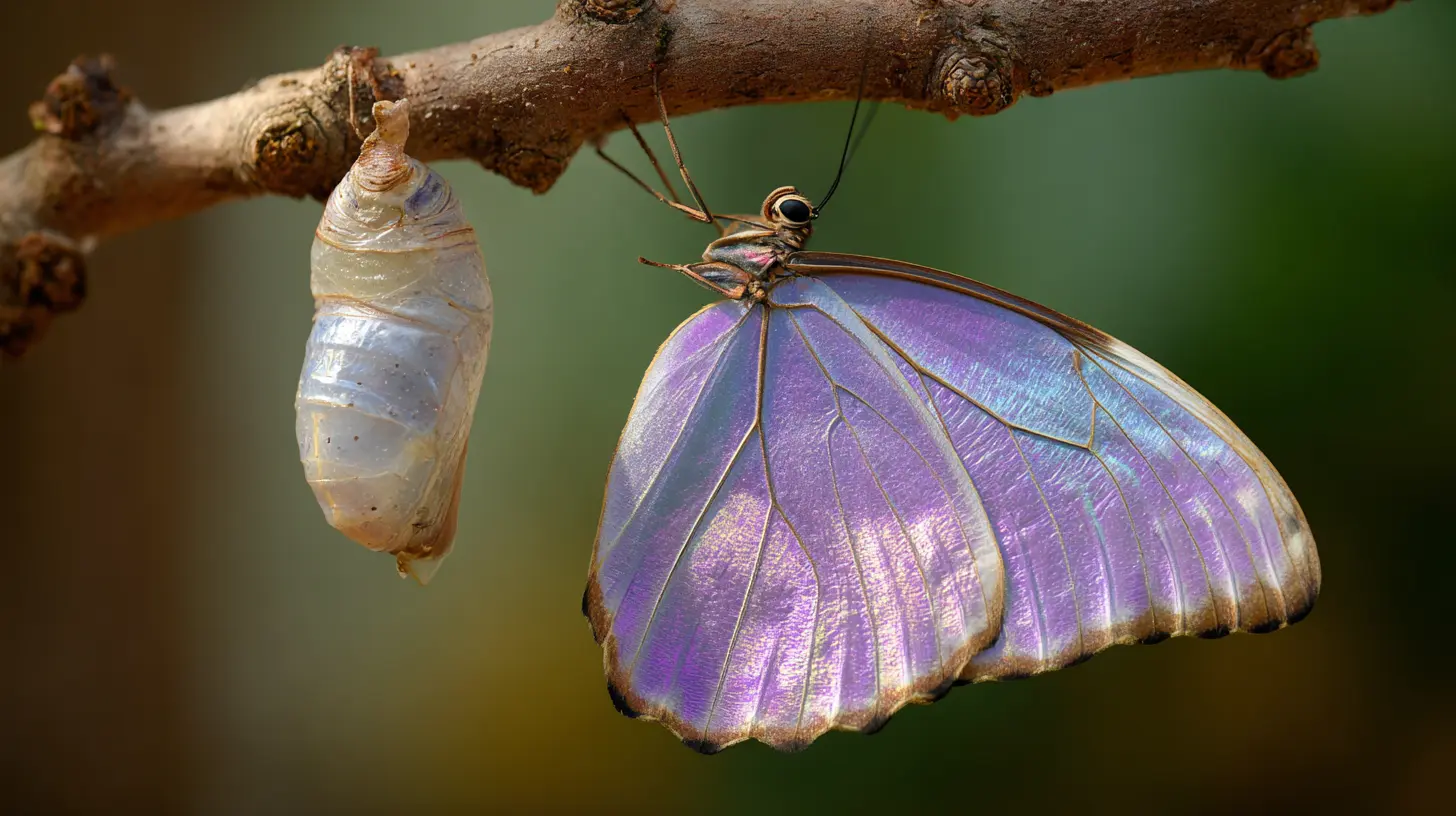
If we seek evidence of death followed by resurrection, we need look no further than the transformation of a caterpillar into a butterfly. Truly, it is a miracle that happens every day, yet we often overlook its profound spiritual significance.
Within its protective casing, the caterpillar doesn’t simply grow wings and learn to fly. Something far more radical occurs. The caterpillar digests itself. Enzymes are released that kill the caterpillar and destroy all of its organs, turning everything into a mushy soup. If you were to open a cocoon during this phase, you would find no sign of the original caterpillar. It is gone—completely dissolved, utterly destroyed.
Yet hidden within this dissolution are “imaginal cells”—cells that carry the blueprint for an entirely new creature. Initially, the caterpillar’s immune system attacks these imaginal cells, recognizing them as foreign. But the imaginal cells persist, multiply, and eventually begin to clump together, forming the organs of an entirely new organism with completely different anatomical features.
The caterpillar dies. The butterfly is born. They are biologically distinct life forms. This is not mere metamorphosis—it is death and resurrection.
We are called to this same radical transformation. Not to improve ourselves or become better versions of who we already are, but to die to our old selves and be resurrected as something entirely new. This is what it means to be “born again” in the Spirit. This is the promise of Easter and Passover—that death is not the end but the doorway to new life.
Between Divine Truth and Human Reality
God creates truth—absolute, immutable, eternal. Yet we, in our finite understanding, form reality through perception, interpretation, and meaning. Between these two forces operates the Word—the Logos—continuously reforming and reshaping reality through revelation, understanding, and divine communication.
Our concept of the Universe evolves with each new empirical observation, each discovery fundamentally altering not just our knowledge but the very fabric of reality as we experience it. When Copernicus revealed that Earth orbits the Sun, reality itself shifted. When quantum mechanics emerged, the deterministic universe dissolved into probability and uncertainty.
The past, too, is not fixed but fluid, continuously reconstructed through the act of remembering and the choice of what to remember. We determine the reality of what was through the lens of what is—our present memory, our current focus, our selective attention to what we deem significant.
In this dance between divine truth and human reality, between absolute and relative, between what is and what we perceive to be, we find ourselves as active participants in the ongoing creation of existence itself. We are not passive observers but co-creators with God, shaping reality through our consciousness, our choices, and above all, our love.
Making Love Tangible: The Sacrament of Presence
But how do we make this love real? How do we move it from the realm of beautiful ideas into the messy, embodied reality of daily life?
We do it through presence. Through touch. Through the willingness to sit with someone in their darkest hour without flinching, to hold space for mystery without rushing to fix or explain, to love through and beyond death.
We do it by becoming like salt—that invisible but essential element that brings out the best in everything it touches. We give purpose, meaning, and desire to life not through grand gestures but through small acts of loving kindness, through the daily choice to see the goodness in others and to trust our own goodness.
We do it by practicing makrothumia—that divine patience that endures without resentment, that remains open even when openness hurts, that chooses compassion over judgment, tenderness over hardness.
We do it by allowing ourselves to be transformed, like the caterpillar, even when transformation requires us to dissolve everything we thought we were.
Becoming a Beacon of Light
As we reflect on life and death as one continuous mystery, we are drawn into ourselves in a deep way. We desire to become better versions of ourselves—not through self-improvement programs or positive thinking, but through genuine spiritual transformation.
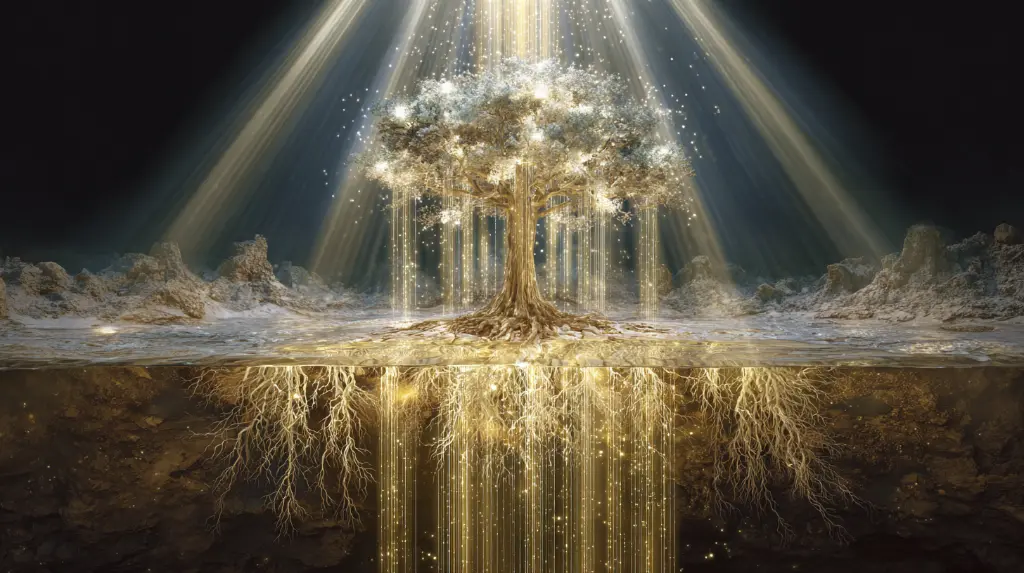
This transformation happens when we create in ourselves kenosis—the emptying of self that makes room for the Divine. When we become entirely receptive to God’s will, we discover that we are not diminished but expanded. We become vessels of light, channels of grace, instruments of peace.
To become a beacon of light is to embody both the masculine and feminine aspects of the Divine. It is to carry strength and gentleness, clarity and compassion, the fire of conviction and the water of tears. It is to understand intellectually the mysteries of death and transformation, and then to express that understanding through sacred presence, through the willingness to touch and be touched, to anoint and be anointed.
Christian mystic writer Matthew Fox writes that, when we tap into that energy we become alive again and we give birth. From the creativity that we release is born the prophetic vision and work that we all aspire to realize as our gift to the world. We want to serve in whatever capacity we can. Getting in touch with the mystic inside is the beginning of our deep service.
The Invitation
This Easter, Passover, and Spring, we are invited into the great mystery of death and resurrection. We are called to let go of our need to control, to release our grip on certainty, to allow ourselves to be dissolved and reformed by the Spirit’s movement.
We are invited to practice humility—not as self-deprecation but as the strength to hold others high.
We are called to be salt—giving taste and meaning to life through our quiet, persistent presence.
We are asked to cultivate makrothumia—that divine patience that endures all things with grace.
We are challenged to move through our grief, not around it or away from it, but through it—allowing the Spirit to carry us to a new place where Agape love dwells. A place where we can hold both sorrow and joy, absence and presence, death and the promise of eternal life.
We are reminded that we are pilgrims, foreigners and strangers on earth, our hearts set on a destination we cannot yet fully see. Yet we walk by faith, trusting that all those on a liberation journey are called to listen, to learn, and then to act—to bring a more fruitful future into the world.
My personal mantra, my Ner Tamid (eternal light), is this: “Create in me kenosis, so I may be Divinity—and live seeking truth, beauty, and love in that Light.”
May this be our shared prayer this season. May we allow ourselves to be emptied so that we may be filled. May we die to our old selves so that we may be resurrected as beacons of light. May we practice the divine patience that reflects God’s own character. May we become salt that gives taste to life, humble servants who hold others high, pilgrims whose hearts are set on the journey toward God.
For in the end, love is the only real thing that matters. Love is as strong as death. Love is the animating force that holds all creation together. And when we live in love until the moment we die, we will not die even when we die.
“The Spirit and the Bride say, Come! And let him who hears say, Come! Whoever is thirsty, let him come; and whoever wishes, let him take the free gift of the water of life” (Revelation 22:17).
May we be awakened to a life forward in health and love. May we embrace all of life as one family—Brother Sun, Sister Moon, and even Sister Death, which is Life. May we learn to let go, let be, and let come—allowing ourselves to be taken up into the Spirit’s movement, transformed from caterpillar to butterfly, from crawling to flying, from death to resurrection.
The flame burns on. The soul endures. Love prevails.
Happy Easter. Happy Passover. Happy Spring.





4 Responses
Merci infiniment pour ce long message en ce jour de Pâques
What a beautiful essay! I sense the presence of Jesus Christ more strongly than ever before, and feel that the Christ energy is abundantly flowing to us at this momentous time.
Your words carry such strength. Much needed and appreciated at this time.
Happy Easter, Happy Spring and happy renewal!
Your words are wise and bring great comfort confirming that with love and hope we will all get through. Happy Easter , Happy Spring and Happy Renewal.