
There is substantial evidence that spiritual well-being is an important determinant of overall health, longevity and quality of life, especially in patients with severe illness. But while most physicians would agree that spiritual well-being is an important factor in their patients’ health, the spiritual needs and well-being of patients are largely ignored and rarely addressed by healthcare providers.
I believe this is a significant oversight in patient care. Spirituality is perhaps the single most important source of strength and direction in life. When we incorporate spiritual well-being into healing, we recognize that people are not simply physical bodies requiring only mechanical fixing.
Life Without God is a Disenchanted Life
Although modern medicine tends to view the body in reductionistic terms, we are not machines. We are living beings in need of interaction, friendship, care, and love. The Creator of all living things intercedes for us through one another, within our outpouring of love. This love can only be conveyed through a person-to-person, person-to-animal, or person-to-plant relationship.
“Fixing and helping may be the work of the ego, and service the work of the soul”
– Rachel Remen, MD
When we view life through a secular modern lens without God or Spirituality, we see a disenchanted universe without meaning, purpose, or direction. We have no sense of belonging, and see only what life is not, instead of what it is or what it can be.
Spirituality offers us a deep sense of meaning and purpose in life, together with a sense of belonging. This is an essential piece of wellness. I find it interesting that the word “health” comes from the old English word meaning “whole” and “holy.” Thus, to be healthy is to be whole and holy. In Isaiah 6:3 we see that the Lord of hosts is not merely holy, but “holy, holy, holy.” One Lord, but three times holy.
“Wellness can be defined rather abstractly as intellectual, spiritual, emotional, and physical vitality; engaging in attitudes and behaviors that enhance the quality of life.” – Donald Yance
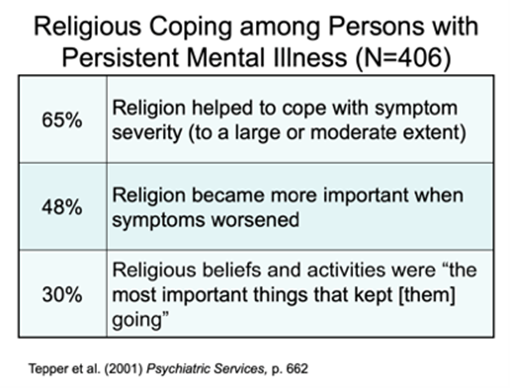
Some people shy away from religion because they view it as rigid and dogmatic. But the essence of spirituality is acceptance, unity, and wholeness. Spirituality encompasses morals, ethics, and values, along with connection to others. This core need applies to everyone, even those who do not believe in God or a higher being. For an individual, spiritual or religious beliefs offer solace and guidance in times of emotional stress, illness, loss, and bereavement.
Spirituality Improves the Lives of People with Cancer
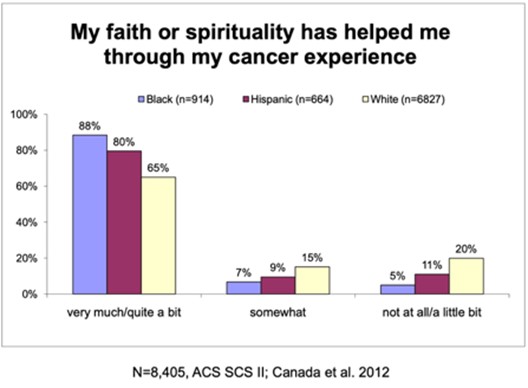
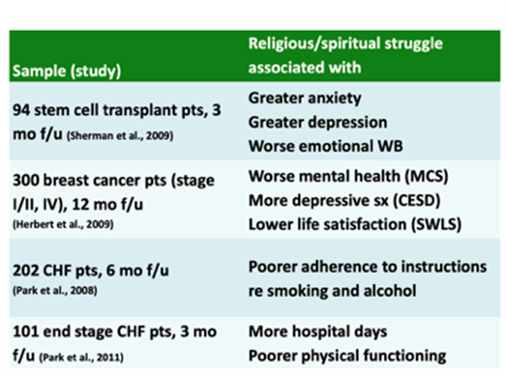
In my clinical practice, I’ve found that people who attend to their spiritual well-being navigate their journey through cancer diagnosis and treatment with more ease. Researchers have noted the same, as reflected in the chart below:
Religion and spirituality are generally accepted as a subsystem of culture, and are considered as a way of life that motivates followers to strive for achieving certain values.
A study published in The International Journal of Indian Psychology found that people who are more spiritual and who feel that their lives have purpose and meaning are generally happier than their non-spiritual counterparts.
Another study published in JAMA Network Open found that multiple aspects of religion and spirituality are associated with reduced anxiety, depression, and fatigue among adolescent and young adults with cancer, all of which were indirectly associated with their sense of meaning and peace. The authors noted that, “Individual and group interventions addressing meaning for people with cancer have shown efficacy for increasing spiritual well-being and for decreasing anxiety, depression, and pain. Referrals for specialty spiritual care from clinically trained chaplains may also be beneficial.”
Prayer and Healing
When someone is ill and we pray for them, we are able to give them love, kindness, compassion, and will them true healing and wellness. “Willing” is a free and conscious act of our will, a decision that becomes an attitude. We say “willing” instead of “giving” because often we cannot give what we would like—good health, for example—to a sick person. But in many cases, we can offer our willingness to encourage healing, as well as nourishment, compassion, companionship, and any and all other gifts we may have to offer.
This is an act of “true goodness.” It is not what we might selfishly want, or what they might mistakenly want. Instead, it is what our best judgment of conscience tells us that God wants for them. When we can see the image of God where we don’t want to (often in our illness) is when we see with eyes that are not our own.
There are two things I share with patients regarding God. The first is, “Rather than tell God about your illness, try telling your illness about God.” And secondly, “Every day, take a moment to reflect on your life from your deathbed, thinking about what truly matters and how differently you wish you had lived. Now become that person.”
The prayer can be a simple petition such as this simple prayer, “Almighty, eternal, just, and merciful God, grant us the grace to do for You alone what we know You want us to do, and always to desire what pleases You.”
Life is like a seed, and prayer and spirituality are the water and light needed for life to grow and produce flowers of eternal fragrance. Water and light are from God, but we must use them— otherwise the garden does not grow. Prayer is the basic foundation of a spiritual life; it is the alpha and the omega, the beginning and the end.